
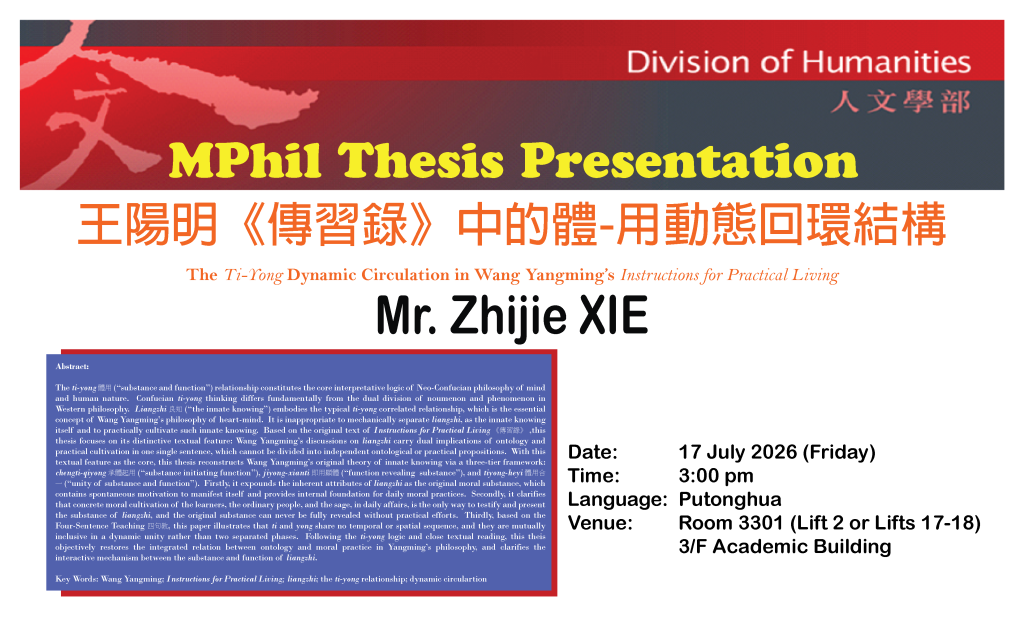
Abstract
The ti-yong體用 (“substance and function”) relationship constitutes the core interpretative logic of Neo-Confucian philosophy of mind and human nature. Confucian ti-yong thinking differs fundamentally from the dual division of noumenon and phenomenon in Western philosophy. Liangzhi良知 (“the innate knowing”) embodies the typical ti-yong correlated relationship, which is the essential concept of Wang Yangming’s philosophy of heart-mind. It is inappropriate to mechanically separate liangzhi , as the innate knowing itself and to practically cultivate such innate knowing. Based on the original text of Instructions for Practical Living《傳習錄》, this thesis focuses on its distinctive textual feature: Wang Yangming’s discussions on liangzhi carry dual implications of ontology and practical cultivation in one single sentence, which cannot be divided into independent ontological or practical propositions. With this textual feature as the core, this thesis reconstructs Wang Yangming’s original theory of innate knowing via a three-tier framework: chengti-qiyong承體起用 (“substance initiating function”), jiyong-xianti 即用顯體 (“function revealing substance”), and tiyong-heyi 體用合一(“unity of substance and function”). Firstly, it expounds the inherent attributes of liangzhi as the original moral substance, which contains spontaneous motivation to manifest itself and provides internal foundation for daily moral practices. Secondly, it clarifies that concrete moral cultivation of the learners, the ordinary people, and the sage, in daily affairs, is the only way to testify and present the substance of liangzhi, and the original substance can never be fully revealed without practical efforts. Thirdly, based on the Four-Sentence Teaching四句教, this paper illustrates that ti and yong share no temporal or spatial sequence, and they are mutually inclusive in a dynamic unity rather than two separated phases. Following the ti-yong logic and close textual reading, this theis objectively restores the integrated relation between ontology and moral practice in Yangming’s philosophy, and clarifies the interactive mechanism between the substance and function of liangzhi.
Key Words:Wang Yangming; Instructions for Practical Living; liangzhi; the ti-yong relationship; dynamic circulation