
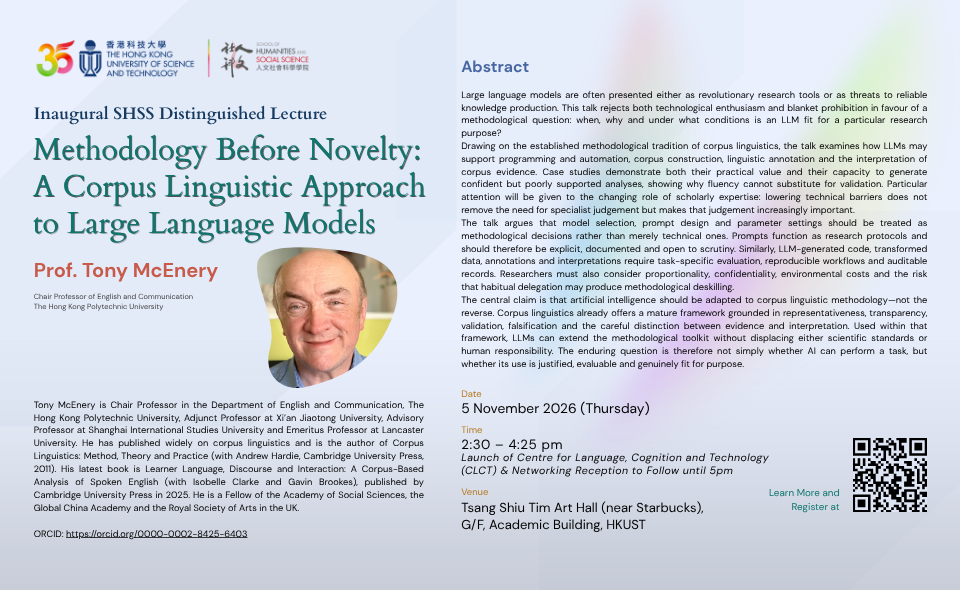
Speaker
Prof. Tony McEnery
Chair Professor of English and Communication
The Hong Kong Polytechnic University
Bio
Tony McEnery is Chair Professor in the Department of English and Communication, The Hong Kong Polytechnic University, Adjunct Professor at Xi’an Jiaotong University, Advisory Professor at Shanghai International Studies University and Emeritus Professor at Lancaster University. He has published widely on corpus linguistics and is the author of Corpus Linguistics: Method, Theory and Practice (with Andrew Hardie, Cambridge University Press, 2011). His latest book is Learner Language, Discourse and Interaction: A Corpus-Based Analysis of Spoken English (with Isobelle Clarke and Gavin Brookes), published by Cambridge University Press in 2025. He is a Fellow of the Academy of Social Sciences, the Global China Academy and the Royal Society of Arts in the UK.
ORCID: https://orcid.org/0000-0002-8425-6403
Abstract
Large language models are often presented either as revolutionary research tools or as threats to reliable knowledge production. This talk rejects both technological enthusiasm and blanket prohibition in favour of a methodological question: when, why and under what conditions is an LLM fit for a particular research purpose?
Drawing on the established methodological tradition of corpus linguistics, the talk examines how LLMs may support programming and automation, corpus construction, linguistic annotation and the interpretation of corpus evidence. Case studies demonstrate both their practical value and their capacity to generate confident but poorly supported analyses, showing why fluency cannot substitute for validation. Particular attention will be given to the changing role of scholarly expertise: lowering technical barriers does not remove the need for specialist judgement but makes that judgement increasingly important.
The talk argues that model selection, prompt design and parameter settings should be treated as methodological decisions rather than merely technical ones. Prompts function as research protocols and should therefore be explicit, documented and open to scrutiny. Similarly, LLM-generated code, transformed data, annotations and interpretations require task-specific evaluation, reproducible workflows and auditable records. Researchers must also consider proportionality, confidentiality, environmental costs and the risk that habitual delegation may produce methodological deskilling.
The central claim is that artificial intelligence should be adapted to corpus linguistic methodology—not the reverse. Corpus linguistics already offers a mature framework grounded in representativeness, transparency, validation, falsification and the careful distinction between evidence and interpretation. Used within that framework, LLMs can extend the methodological toolkit without displacing either scientific standards or human responsibility. The enduring question is therefore not simply whether AI can perform a task, but whether its use is justified, evaluable and genuinely fit for purpose.
Registration