
Abstract
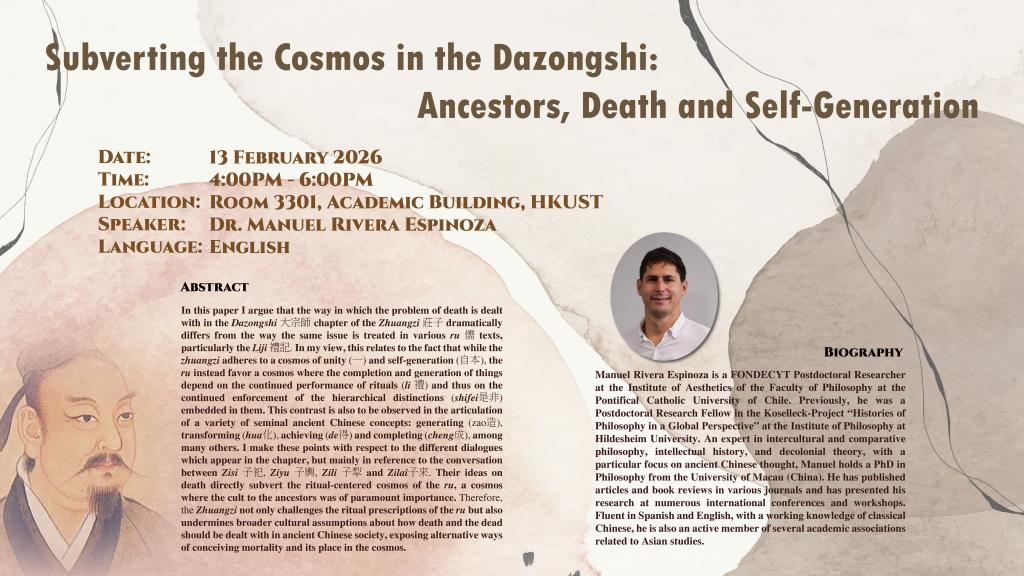
In this paper I argue that the way in which the problem of death is dealt with in the Dazongshi 大宗師 chapter of the Zhuangzi 莊子 dramatically differs from the way the same issue is treated in various ru 儒 texts, particularly the Liji 禮記. In my view, this relates to the fact that while the Zhuangzi adheres to a cosmos of unity (一) and self‑generation (自本), the ru instead favor a cosmos where the completion and generation of things depend on the continued performance of rituals (li 禮) and thus on the continued enforcement of the hierarchical distinctions (shifei 是非) embedded in them. This contrast is also to be observed in the articulation of a variety of seminal ancient Chinese concepts: generating (zao 造), transforming (hua 化), achieving (de 得) and completing (cheng 成), among many others. I make these points with respect to the different dialogues which appear in the chapter, but mainly in reference to the conversation between Zisi 子祀, Ziyu 子輿, Zili 子犁 and Zilai 子來. Their ideas on death directly subvert the ritual‑centered cosmos of the ru, a cosmos where the cult to the ancestors was of paramount importance. Therefore, the Zhuangzi not only challenges the ritual prescriptions of the ru but also undermines broader cultural assumptions about how death and the dead should be dealt with in ancient Chinese society, exposing alternative ways of conceiving mortality and its place in the cosmos.
Biography
Manuel Rivera Espinoza is a FONDECYT Postdoctoral Researcher at the Institute of Aesthetics of the Faculty of Philosophy at the Pontifical Catholic University of Chile. Previously, he was a Postdoctoral Research Fellow in the Koselleck-Project “Histories of Philosophy in a Global Perspective” at the Institute of Philosophy at Hildesheim University. An expert in intercultural and comparative philosophy, intellectual history, and decolonial theory, with a particular focus on ancient Chinese thought, Manuel holds a PhD in Philosophy from the University of Macau (China). He has published articles and book reviews in various journals and has presented his research at numerous international conferences and workshops. Fluent in Spanish and English, with a working knowledge of classical Chinese, he is also an active member of several academic associations related to Asian studies.
Dr. Rivera Espinoza is a young voice in the study of the Zhuangzi. His work challenges neo-orientalist tendencies in Western scholarship on Chinese philosophy and attempts to decolonize current perspectives on early Chinese classics by focusing on Latin-American voices. In addition to sharing some of his knowledge on proto-Daoism with the students, his presentation would also diversify our portfolio of scholars who present at HKUST since most come from either Mainland China and/or Chinese diaspora, as well as the US or Europe.