AI Matches Human Teachers: HKUST Study Finds a Brief Pre-Lecture Chat Boosts Students' Brain Synchrony and Learning Outcomes
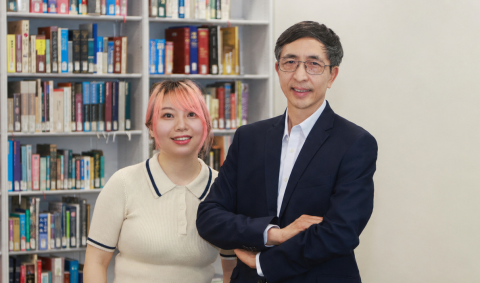
Prof. LI Ping, Dean of the School of Humanities and Social Science and Chair Professor of Psychology and Cognitive Science at HKUST (right) and Dr. PENG Yingying, HKUST Postdoctoral Fellow and the paper’s first author (left). Prof. Li led the research team to find that a brief one-on-one pre-lecture conversation—whether with a human or an AI instructor—improves students’ neural synchrony and learning outcomes.
Millions of students worldwide have long relied on self-paced learning through pre-recorded video lectures, a model that forms the backbone of massive open online courses (MOOCs) and large-scale online education. Since the COVID-19 pandemic, dependence on video-based online learning has increased significantly, with learner participation rising sharply. However, this expansion has also been accompanied by a widespread decline in student engagement, undermining overall learning outcomes.
A research team at The Hong Kong University of Science and Technology (HKUST), led by Prof. LI Ping, Dean of the School of Humanities and Social Science and Chair Professor of Psychology and Cognitive Science, has found that a brief one-on-one pre-lecture conversation (8–10 minutes) — whether with a human or an AI instructor — improves students’ neural synchrony and learning outcomes.
Human and AI instructors achieve comparable learning outcomes, but through different neural pathways. Human interaction engages both cognitive scaffolding and strong social-emotional processing, mediated by gaze alignment, while AI interaction supports more top-down cognitive processing. The study shows that AI-led and human-led pre-class interactions yield statistically indistinguishable learning outcomes across recall, comprehension, and knowledge transfer.
The study, published in the leading international academic journal Neuron under the title "Scaffolding human and AI instruction: neural alignment and learning gains in online education," provides the first neuroscientific evidence that AI instructors can match their human counterparts in improving online learning quality.
Reference:
https://www.wenweipo.com/a/202605/08/AP69fcf60ce4b0b49ad1b9f448.html