
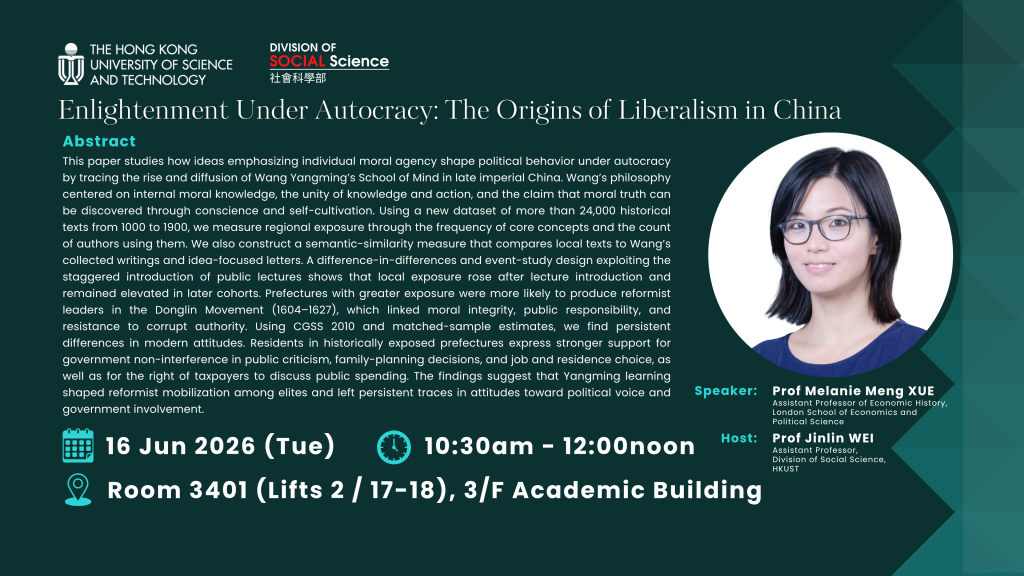
This paper studies how ideas emphasizing individual moral agency shape political behavior under autocracy by tracing the rise and diffusion of Wang Yangming’s School of Mind in late imperial China. Wang’s philosophy centered on internal moral knowledge, the unity of knowledge and action, and the claim that moral truth can be discovered through conscience and self-cultivation. Using a new dataset of more than 24,000 historical texts from 1000 to 1900, we measure regional exposure through the frequency of core concepts and the count of authors using them. We also construct a semantic-similarity measure that compares local texts to Wang’s collected writings and idea-focused letters. A difference-in-differences and event-study design exploiting the staggered introduction of public lectures shows that local exposure rose after lecture introduction and remained elevated in later cohorts. Prefectures with greater exposure were more likely to produce reformist leaders in the Donglin Movement (1604–1627), which linked moral integrity, public responsibility, and resistance to corrupt authority. Using CGSS 2010 and matched-sample estimates, we find persistent differences in modern attitudes. Residents in historically exposed prefectures express stronger support for government non-interference in public criticism, family-planning decisions, and job and residence choice, as well as for the right of taxpayers to discuss public spending. The findings suggest that Yangming learning shaped reformist mobilization among elites and left persistent traces in attitudes toward political voice and government involvement.
Melanie Meng Xue is an Assistant Professor of Economic History at the London School of Economics and Political Science (LSE) and a Research Affiliate at the Centre for Economic Policy Research (CEPR). Her research interests include political economy, gender, culture and narrative, and early modern and modern China.
Her work includes research on the rise of women, the self-perpetuation of authoritarian regimes, and the consequences of affirmative action policies. By tracing the impact of historical events over time and in various institutional settings, her work centers on the role of values, beliefs, and norms in shaping economic and political disparities.
In her research on historical narratives, she has found that folklore is a crucial source of cultural values. In a more recent project, she explores cultural change following the Industrial Revolution through the study of proverbs. Another ongoing line of inquiry concerns cultural values in China across space and time, within and between ethnic groups. A book expanding this line of research is currently in progress.
Host: Prof Jinlin WEI, Assistant Professor, Division of Social Science, HKUST