
Abstract
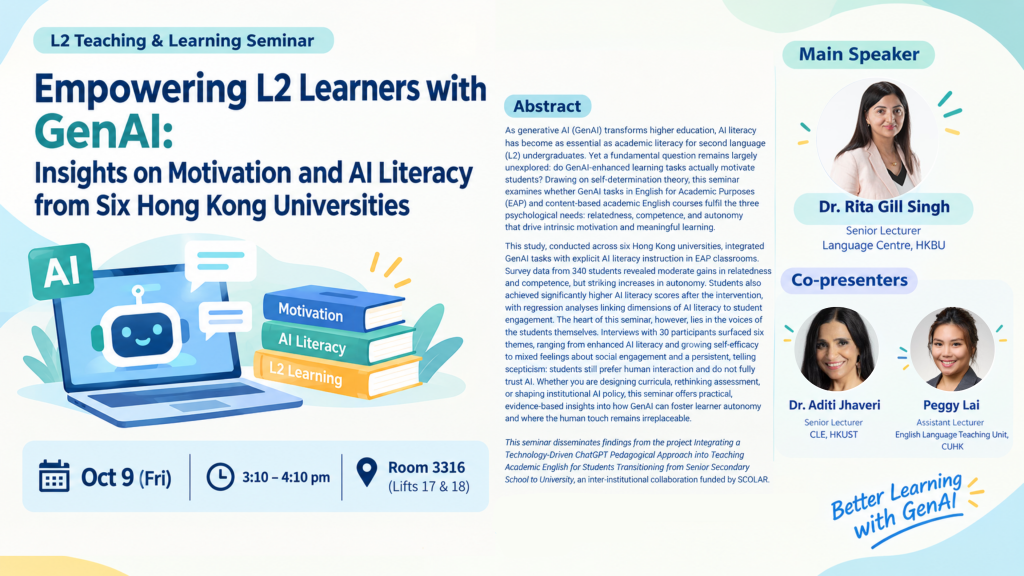
As generative AI (GenAI) transforms higher education, AI literacy has become as essential as academic literacy for second language (L2) undergraduates. Yet a fundamental question remains largely unexplored: do GenAI-enhanced learning tasks actually motivate students? Drawing on self-determination theory, this seminar examines whether GenAI tasks in English for Academic Purposes (EAP) and content-based academic English courses fulfil the three psychological needs: relatedness, competence, and autonomy that drive intrinsic motivation and meaningful learning. This study, conducted across six Hong Kong universities, integrated GenAI tasks with explicit AI literacy instruction in EAP classrooms. Survey data from 340 students revealed moderate gains in relatedness and competence, but striking increases in autonomy. Students also achieved significantly higher AI literacy scores after the intervention, with regression analyses linking dimensions of AI literacy to student engagement. The heart of this seminar, however, lies in the voices of the students themselves. Interviews with 30 participants surfaced six themes, ranging from enhanced AI literacy and growing self-efficacy to mixed feelings about social engagement and a persistent, telling scepticism: students still prefer human interaction and do not fully trust AI. Whether you are designing curricula, rethinking assessment, or shaping institutional AI policy, this seminar offers practical, evidence-based insights into how GenAI can foster learner autonomy and where the human touch remains irreplaceable.
This seminar disseminates findings from the project Integrating a Technology-Driven ChatGPT Pedagogical Approach into Teaching Academic English for Students Transitioning from Senior Secondary School to University, an inter-institutional collaboration funded by SCOLAR.
Speaker Biography
Rita Gill SINGH is a Senior Lecturer at the Language Centre, Hong Kong Baptist University. She has published in the Journal of English for Academic Purposes, Discourse & Communication, Journal of Business and Technical Communication, International Journal of Business Communication, and English for Specific Purposes.
Co-presenters: Dr. Aditi Jhaveri, Senior Lecturer, Center for Language Education, Hong Kong University of Science and Technology; Ms. Peggy Lai, Assistant Lecturer, English Language Teaching Unit, Chinese University of Hong Kong