
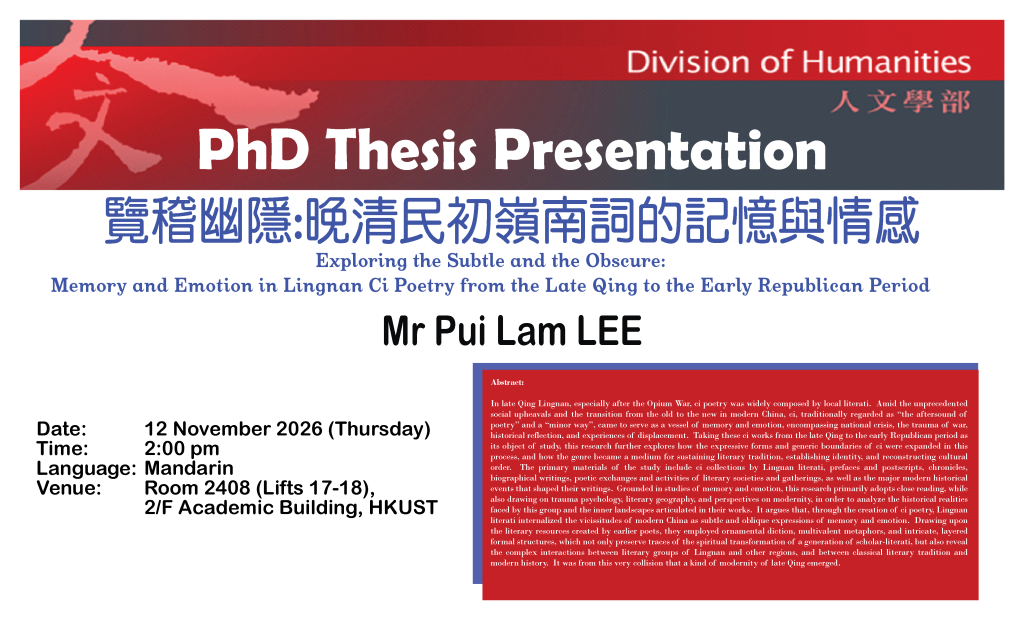
Abstract:
In late Qing Lingnan, especially after the Opium War, ci poetry was widely composed by local literati. Amid the unprecedented social upheavals and the transition from the old to the new in modern China, ci, traditionally regarded as “the aftersound of poetry” and a “minor way”, came to serve as a vessel of memory and emotion, encompassing national crisis, the trauma of war, historical reflection, and experiences of displacement. Taking these ci works from the late Qing to the early Republican period as its object of study, this research further explores how the expressive forms and generic boundaries of ci were expanded in this process, and how the genre became a medium for sustaining literary tradition, establishing identity, and reconstructing cultural order. The primary materials of the study include ci collections by Lingnan literati, prefaces and postscripts, chronicles, biographical writings, poetic exchanges and activities of literary societies and gatherings, as well as the major modern historical events that shaped their writings. Grounded in studies of memory and emotion, this research primarily adopts close reading, while also drawing on trauma psychology, literary geography, and perspectives on modernity, in order to analyze the historical realities faced by this group and the inner landscapes articulated in their works. It argues that, through the creation of ci poetry, Lingnan literati internalized the vicissitudes of modern China as subtle and oblique expressions of memory and emotion. Drawing upon the literary resources created by earlier poets, they employed ornamental diction, multivalent metaphors, and intricate, layered formal structures, which not only preserve traces of the spiritual transformation of a generation of scholar-literati, but also reveal the complex interactions between literary groups of Lingnan and other regions, and between classical literary tradition and modern history. It was from this very collision that a kind of modernity of late Qing emerged.